EPLO Executive Director Sonya Reines-Djivanides has written to Ministers for Development Cooperation urging them to ensure the next Global Europe instrument is equipped to address the root causes of fragility and build peace.
The European Peacebuilding Liaison Office (EPLO), founded in 2001, is the largest independent European civil society platform of European NGOs, NGO networks and think tanks that are committed to peacebuilding and the prevention of violent conflict.
Our strength resides in our +50 member organisations. This diverse and dedicated network of civil society actors drives our mission forward. We represent a wide range of organisations united by a shared objective: to promote peace and prevent violent conflict.
Agency for Peacebuilding
Berghof Foundation
Budapest Centre for Mass Atrocities Prevention
Build Up
Center for Civilians in Conflict (CIVIC)
Centre for Humanitarian Dialogue (HD Centre)
Christian Aid Ireland
CMI – Martti Ahtisaari Peace Foundation
Conciliation Resources
Concordis International
Conducive Space for Peace
Cordaid
CSSP – Berlin Center for Integrative Mediation
ESSEC IRENÉ
European Centre for Electoral Support
FSD France
Geneva Call
German Platform for Peaceful Conflict Transformation
Global Partnership for the Prevention of Armed Conflict (GPPAC)
HALO Trust
Humanity & Inclusion – HI
Independent Diplomat
Institute of Studies on Conflicts and Humanitarian Action
International Alert Europe
International Catalan Institute for Peace
International Center for Transitional Justice
International Coalition of Sites of Conscience Europe
International Crisis Group
Interpeace
Kosovar Center for Security Studies
Life & Peace Institute
Mines Advisory Group
Nansen Center for Peace and Dialogue
Near East Foundation – Belgium
New Social Initiative
Non Violent Peaceforce
Oxfam International
Partners Bulgaria
Pax Christi International
PAX Netherlands
Peace Action, Training and Research Institute of Romania
Peace Direct
PeaceWomen Across the Globe
Quaker Council for European Affairs
SaferGlobe
Saferworld
Sant’Egidio BXL Europe
Search for Common Ground
Sustainable Cooperation for Peace and Security
swisspeace
The Shaikh Group
Transparency International – Defence & Security
Un Ponte Per
WeWorld
Women in International Security
World Vision
Youth Initiative for Human Rights
What we do
CSDN
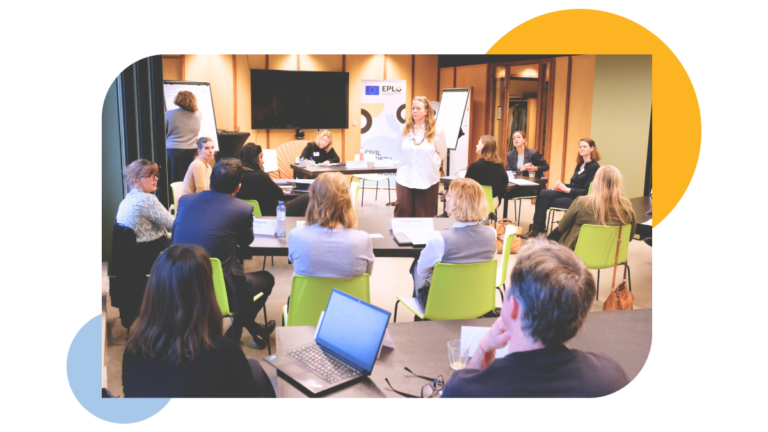
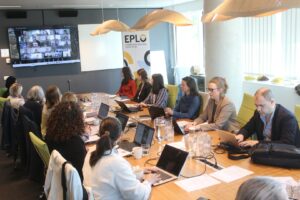
The Civil Society Dialogue Network (CSDN) is a platform for dialogue between civil society and EU policymakers on peace and conflict. It’s co-funded by the EU and EPLO and managed by EPLO in cooperation with the EC and EEAS.
Established in 2010, CSDN V (2023-2026) organizes dialogue meetings in Brussels, EU Member States, and conflict-affected countries with EU presence.